
Dietary guide
Is Udon Halal in Japan? What Muslim Travelers Need to Check
© MemColorLab / CC BY-SA 4.0, via Wikimedia Commons · CC BY-SA 4.0
Udon is not automatically halal — the plain noodles are usually fine, but the broth is where the problem lives. Standard udon noodles are just wheat flour, salt, and water, with no meat or alcohol. What makes a bowl questionable is the soup: most Japanese udon broth is seasoned with mirin and cooking sake (both alcoholic), and some versions are built on pork or chicken stock. Here is exactly what to check so you can eat udon in Japan with confidence.
The noodles are fine — the broth is the question
The udon noodle itself contains no animal product and no alcohol, so on its own it raises no halal concern (it is not gluten-free, though — it is pure wheat; if avoiding gluten rather than alcohol is your concern, see is udon gluten-free in Japan). The moment noodles meet soup, everything depends on the dashi (stock) and the seasonings dissolved into it.
Most restaurant udon uses awase dashi — a blend of kombu (kelp) and katsuobushi (dried bonito). Fish is permissible for the vast majority of Muslims and does not require Islamic slaughter, so bonito dashi by itself is generally accepted. The real issues are the sweeteners and any meat stock added to the pot.
What's actually in udon broth
| Ingredient | Halal status | Why |
|---|---|---|
| Kombu / shiitake dashi | Fine | Plant-based, no alcohol |
| Katsuobushi (bonito) dashi | Fine for most | Fish needs no ritual slaughter |
| Mirin (hon-mirin) | Problem | Sweet rice wine, ~14% alcohol |
| Cooking sake (ryōrishu) | Problem | Rice wine, alcoholic |
| Soy sauce (shoyu) | Debated | Naturally brewed shoyu carries ~2% alcohol as a fermentation by-product; some scholars permit the trace, stricter ones avoid it |
| Pork / chicken stock | Haram (pork) / needs halal meat (chicken) | Used in some regional and curry udon |
The headline risk is mirin. Real hon-mirin is roughly 14% alcohol — closer to wine than to a splash of flavoring — and it is in a large share of udon broths, glazes, and simmered toppings. Cooking sake is the same story. Cooks will often say the alcohol "boils off," but there is no guarantee, and for many Muslims the source ingredient itself is the issue.
Udon type by type
| Udon | Watch for | Muslim-friendly? |
|---|---|---|
| Kake udon (plain hot broth) | Mirin, sake, soy sauce | Best base to negotiate |
| Kitsune udon (sweet fried tofu) | Tofu simmered in mirin + sugar dashi | Tofu is fine, sweet liquid is the risk |
| Niku udon (beef) | Non-halal beef + mirin/sake glaze | Only at a halal shop |
| Curry udon | Curry roux often has animal fat/meat + alcohol | Usually avoid |
| Tempura udon | Shared fryer oil (see below) + broth | Ask about the fryer |
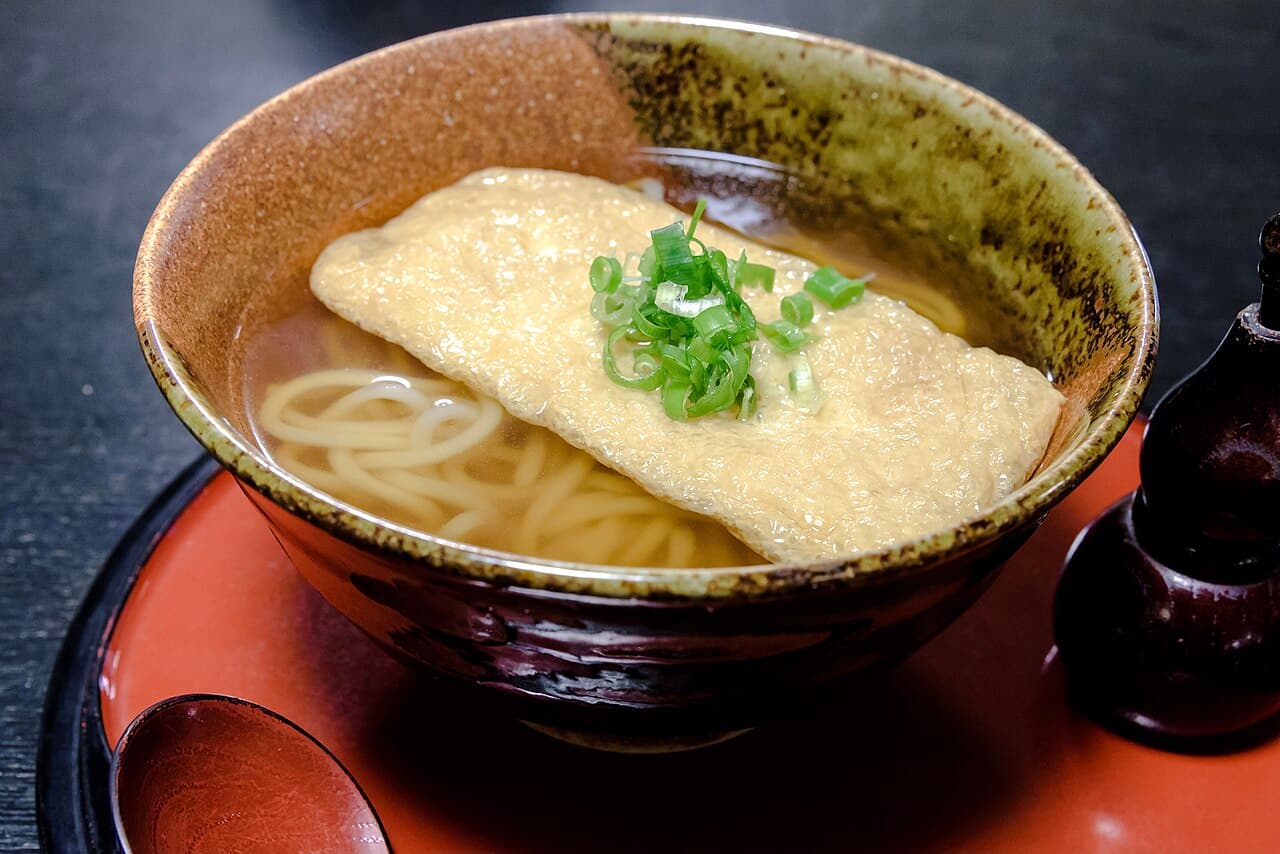
Kitsune udon looks safe because the topping is just aburaage (fried tofu), but that tofu is normally simmered in a sweet mixture of dashi, soy sauce, sugar, and mirin, so the sweetened liquid is the thing to ask about.
Hidden traps most guides miss
- Shared fryer oil. Tempura udon toppings are fried in oil that may also fry pork cutlets, shrimp, and other items. Even a "vegetable" tempura can be cooked in cross-contaminated oil.
- Curry udon roux. Japanese curry roux frequently contains animal fats and sometimes pork extract, plus wine or sake. Treat curry udon as haram unless the shop states otherwise.
- "Just a splash" of sake. Many broths get a finishing splash of sake or mirin that never appears on the menu. You must ask.
- Instant dashi powder. Home-style and cheap shops sometimes use granules that include additives; halal-certified dashi exists but is not the default.
How to order udon as a Muslim traveler
Show staff a phrase card. Useful lines:
- みりんや料理酒は使っていますか? (Mirin ya ryōrishu wa tsukatte imasu ka?) — "Do you use mirin or cooking sake?"
- 豚や鶏のだしは入っていますか? (Buta ya tori no dashi wa haitte imasu ka?) — "Is there pork or chicken stock in it?"
- アルコールを使わずに作れますか? (Arukōru o tsukawazu ni tsukuremasu ka?) — "Can you make it without alcohol?"
If the answers are unclear, the safest self-catered move is plain boiled udon with your own halal-certified soy sauce, or a kombu/shiitake broth with no mirin. That plant-based broth is also the meat-free route — if diet rather than faith is your reason for skipping the fish dashi, see is udon vegan.
Halal-friendly and certified udon options
The cleanest path is a shop that is actually halal-certified or Muslim-run. The clearest verified example is Kineya Mugimaru, an udon specialist whose kitchen is certified by the Japan Halal Association; its branch on the 5th floor of Narita Airport Terminal 1 (Central Building, before security; roughly 07:30–20:30) serves halal udon with beef, chicken-curry, or fried-tofu toppings — a handy first or last bowl in Japan. To find more, search a certification directory such as Halal Gourmet Japan or Muslim-Guide.jp rather than assuming any random shop qualifies. Large chains such as Marugame Seimen are not halal-certified in Japan (as of 2026); some Muslims eat there judging that heated seasonings leave little residual alcohol, but that is a personal call, not a certification. For a bowl with history, older Osaka udon houses like Imai Honten in Dotonbori are worth confirming ingredients with directly — note it is not halal-certified.
Udon follows the same logic as ramen — see our companion guide on whether ramen is halal in Japan — and both fit into the bigger picture in our halal Japan travel guide. Ask the two questions above, choose kake over curry, and udon becomes one of the easier Japanese meals to enjoy.
Read the label: the Japanese that decides it
The noodles themselves are flour, water and salt. Everything that decides the question is in the broth and the toppings.
| Japanese | Rōmaji | What it tells you |
|---|---|---|
| つゆ / だし | tsuyu / dashi | The broth — dashi, soy sauce and usually mirin. |
| 肉うどん | niku udon | "Meat udon" — beef or pork depending on the region. |
| 天かす | tenkasu | Tempura crumbs, fried in oil shared with other items. |
| かまぼこ | kamaboko | Fish cake; check for 酒精 on packaged versions. |
| 豚汁 | tonjiru | Pork soup — a common side, and exactly what it says. |
What to say at the counter
Showing this on a screen works as well as saying it — staff read it faster than they parse spoken English.
つゆにみりんやお酒は入っていますか?
Tsuyu ni mirin ya osake wa haitte imasu ka?
“Does the broth contain mirin or sake?”
Places we’ve confirmed
Dotonbori Imai Honten: Kitsune Udon in Osaka
Kitsune udon — sweet fried tofu over a delicate kombu-and-fish dashi
Dotonbori Imai Honten serves kitsune udon in a fish-based kombu dashi in Osaka.
Last verified Jul 2026- Casual
- Solo
- Date
Sources
- Is Dashi Halal? What Every Muslim Traveler Needs to Know in Japan — Halal Food Maps
- Halal in Japan: Complete Ingredient Guide for Muslim Expats — HalalLens
- Is Marugame Seimen Halal? Eat this way if you want to make it Halal — Paulonia
- Kitsune Udon きつねうどん — Just One Cookbook
- All About Mirin (Japanese Sweet Rice Wine) — Just One Cookbook
- Kineya Mugimaru Narita Airport Terminal 1 (Halal-certified udon) — Halal Food in Japan
- Muslim-Friendly Soba/Udon Restaurants in Japan — Muslim Guide
FAQ
- Is udon halal in Japan?
- Not automatically. The noodles (wheat, salt, water) are fine, but most udon broth is seasoned with mirin and cooking sake, which are alcoholic, and some versions use pork or chicken stock. Bonito fish dashi itself is acceptable to most Muslims. Udon is halal only when the broth is confirmed free of alcohol and non-halal meat stock, or at a certified shop such as Kineya Mugimaru at Narita Airport.
- Are udon noodles themselves halal?
- Yes. Plain udon noodles are made from just wheat flour, salt, and water — no meat, no alcohol — so the noodle itself raises no halal concern. The problem is never the noodle but the soup and seasonings. Note that because they are pure wheat, udon noodles are not gluten-free, which is a separate dietary issue.
- Is the mirin in udon broth really haram?
- For most Muslims, yes, it is a concern. True hon-mirin is about 14% alcohol — comparable to wine — and it is added to a large share of udon broths and sweet toppings. Cooks often say the alcohol evaporates, but this is not guaranteed and the source ingredient is alcoholic, so many Muslims avoid broths made with mirin or cooking sake.
- Is bonito dashi halal for Muslims?
- Bonito (katsuobushi) dashi is accepted by the vast majority of Muslims, because fish is permissible in Islam and does not require ritual slaughter. Kombu (kelp) and shiitake dashi are also fine. The halal risk in dashi-based broth comes from added mirin, sake, or meat stock — not from the fish or seaweed base itself.
- Where can I eat halal-certified udon in Japan?
- Kineya Mugimaru, an udon specialist on the 5th floor of Narita Airport Terminal 1, is certified by the Japan Halal Association and serves halal udon with beef, chicken curry, or fried tofu. To find more, use a certification directory such as Halal Gourmet Japan or Muslim-Guide.jp. Large chains like Marugame Seimen are not halal-certified in Japan as of 2026, so confirm before eating.